
316L Jewelry Manufacturing Quality Checks
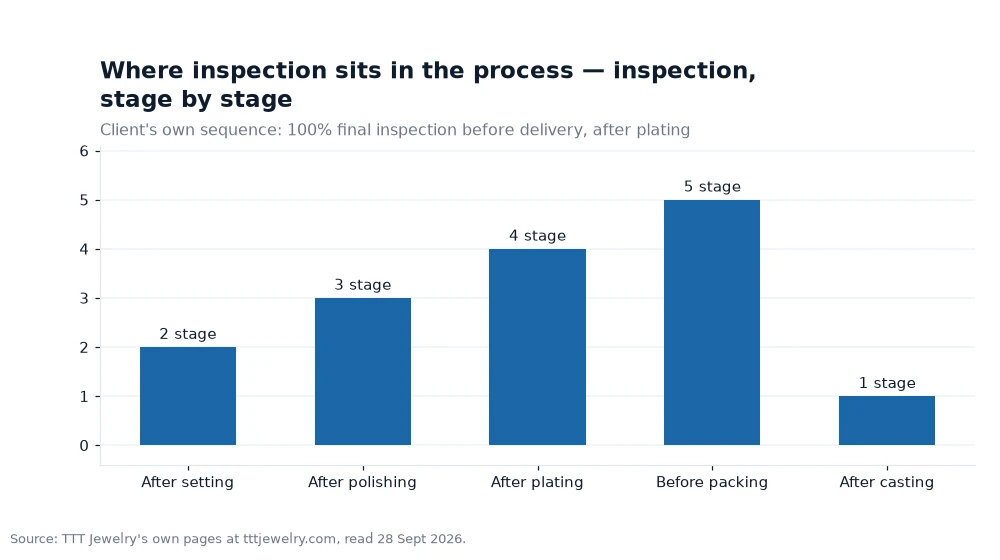
Quality in 316L jewelry is decided at five points, and each one rejects a different kind of fault. Casting catches porosity, setting catches loose stones, polishing catches geometry, plating catches coverage, and packing catches the errors that have nothing to do with metal. The published flow puts 100% inspection at the end, but the earlier checks are what keep that final pass short.

Key takeaways
- Five checkpoints sit between casting and packing, and each one has a distinct failure mode.
- Stainless MOQ starts at 100+ pieces per design, with a 100% final inspection on every piece.
- 316L contains 2–3% molybdenum and is published as waterproof, shower-safe and swim-proof.
- Bulk production runs 3–4 weeks after a 25–30 day sample, giving 48–60 days from CAD to delivery.
Five checks, five failure modes
The first check happens after casting, before any stone is set. A casting is judged on weight against the band, surface soundness and dimensional fit. Porosity is the main enemy: a pit that looks like a speck on a raw casting becomes a crater after polishing, and no amount of plating covers it.
The second check follows setting. A stone can be seated too high, too low or under uneven prong pressure. The test is a light pull and a visual pass across the girdle, not a shake. A stone that moves now will move more after the piece has been worn and cleaned a few times.
The third check is polishing and surface art. Here the measurements are visual and tactile: edge sharpness, texture direction and the amount of material removed. A polished edge that has gone round cannot be restored by the next step, because plating follows the shape it is given.
The fourth is plating or PVD coating. Coverage in recesses, colour consistency across a rack and adhesion at edges are the three questions. The fifth is packing, where function, pairing and labelling are checked. A piece can pass four metal checks and still ship with the wrong card.
| Checkpoint | What is measured | Method | Reject action |
|---|---|---|---|
| After casting | Weight, porosity, dimensions | Scale, visual, gauge | Melt and recast |
| After setting | Seat depth, prong pressure | Light pull, loupe | Reset the stone |
| After polishing | Edge form, texture, wall thickness | Reference tile, caliper | Re-polish or scrap |
| After plating | Coverage, colour, adhesion | Rack comparison, tape test | Strip and recoat |
| Before packing | Clasp, pairing, label data | Function cycle, scan check | Hold the carton |
Casting and setting: faults that survive polishing
Porosity is a structural fault, not a cosmetic one. Gas trapped during casting leaves voids just under the surface, and polishing opens them. A piece with a void at a thin section can look perfect and still crack when a prong is bent or a band is resized. Weight against a known band is a crude test, but it is fast and it flags the outliers before setting labour is spent.
Sprue marks belong to the same gate. The sprue is the channel through which metal entered the mould, and cutting it leaves a scar that polishing must remove. A cut that is too deep removes wall thickness; a cut that is too shallow leaves a bump that shows after coating. Either way, the error is created at step three and discovered at step four.
Setting is where a design's tolerances get tested. A bezel drawn to hold a stone tightly has very little room for a stone that is slightly out of round. A prong setting tolerates more variation but depends on the setter's pressure. Checking every piece at this gate is cheaper than checking every piece after plating, because a reset stone does not require the surface to be stripped.
Plating and packing: the last two gates
The plating gate is where 316L earns its reputation. The alloy takes PVD well, but PVD is line of sight, so a recess that the vapour cannot see stays bare. Rack position also changes the colour slightly across a load, which is why pieces are compared against a reference from the same run rather than against a photograph.
Adhesion is checked at edges, where the film is thinnest and where wear starts. A tape test or a light abrasion at a hidden edge will show whether the coating is bonded or sitting on contamination. The test is destructive, so it is done on a coupon or a scrap piece from the same rack, not on a saleable unit.
Packing is the gate most often staffed by someone outside the quality team, and that is a mistake. Pairing matters: earrings must match in size and colour, and a pair that was split across two trays can ship mismatched. Labels matter more: a barcode that points to the wrong SKU sends a correct piece to the wrong listing, and the customer experiences it as a wrong item.
Function belongs here too. A clasp that has been cycled fifty times at the bench is a different object from one that has been opened twice. The final pass should include a functional cycle for every piece, because a clasp failure is the most common reason a piece comes back regardless of how good the finish is.
Why 316L changes the checklist
The published material note is specific: 316L contains 2–3% molybdenum, is waterproof, shower-safe and swim-proof, and is medical-grade hypoallergenic. Each of those claims has an inspection implication. Waterproof means the finish has to survive repeated exposure, which pushes attention to coating adhesion and to the inside of a ring where water sits.
Hypoallergenic means the alloy and the coating both have to be right, not just the outer colour. REACH compliance covers lead, cadmium and nickel, and plating is published as 100% compliant with REACH and CA Prop 65. A buyer selling into Europe or California should keep those statements tied to the order file, because a compliant catalogue entry is not the same as a compliant batch.
The full material statement is published by TTT Jewelry, and it is the page to attach to a compliance questionnaire rather than summarise from memory.
The checklist also differs by alloy within stainless steel. 304 is published as water-resistant for daily wear and is vacuum-plated for cost-effective volume; 316L is the grade for water exposure. Using the 316L checklist on a 304 order tests for a performance the alloy was never specified to deliver, and using the 304 checklist on 316L leaves the water claim untested.
For a collection that mixes metals, the sterling silver jewelry manufacturer route applies a different set of checks, since silver is soft and takes electroplating rather than PVD. Copying the stainless sheet across would test the wrong properties on both lines.
Worked example
A three-design 316L order at the published floor is 3 × 100 = 300 pieces. With five checkpoints, the run generates 300 × 5 = 1,500 inspection decisions, and the final 100% inspection adds one more full pass over all 300 pieces, for 1,800 touches in total.
Time is tighter than the touch count suggests. CAD takes 48 hours, or 2 days. The master sample takes 25–30 days, equal to 3.6–4.3 weeks. Bulk production takes 3–4 weeks, or 21–28 days. Adding them gives 2 + 25–30 + 21–28 = 48–60 days, roughly 7–9 weeks from CAD release to delivery.
The cost of a missed early gate is visible in rework arithmetic. If porosity in one design is found only after plating, that is 100 pieces stripped, recoated and re-inspected, plus the setting and polishing labour already spent. Finding the same fault after casting costs 100 recasts and nothing else. The earlier gate is not stricter; it is cheaper.
Frequently asked questions
Is every 316L piece inspected before shipping?
Yes. Final QC is published as 100% inspected, meaning each piece is checked rather than a sample drawn from the batch.
What is the order minimum for 316L stainless jewelry?
100+ pieces per design is the published stainless minimum, compared with 100 for brass and 50 for sterling silver.
Does 316L jewelry tarnish in water?
316L is published as waterproof, shower-safe and swim-proof, with 2–3% molybdenum supporting corrosion resistance in daily exposure.
Building a checklist that matches the claim
A quality checklist is only useful if it tests the promise printed on the product page. A water-resistant claim needs an adhesion check at edges and a coating coverage check in recesses. A hypoallergenic claim needs the alloy and the plating documented against REACH. A pairing claim needs a matching step at packing.
The factory direct manufacturing model described on the manufacturer's site places all eight steps under one roof, which is what makes a five-gate checklist practical rather than theoretical. When casting, polishing, coating and packing happen in sequence on one site, a reject can be acted on before the next step adds cost.
Write the checkpoints into the purchase order, name the reference sample, and require the reject record by gate. A checklist that lives only in a factory's own system cannot be audited by the brand that pays for it.
Source note: figures come from the manufacturer's own website (tttjewelry.com), read 28 Sept 2026.[1]