
Supplier A and Supplier B can hand over the same certificate list and still be two entirely different bets. A track record is not a document; it is a pattern of behaviour visible in how quickly questions are answered, how version changes are recorded, and what happens when a project meets a date it cannot move. On a festive gifting range, where the ship window is fixed by the calendar rather than by the factory, that pattern decides the outcome far more than the capability brochure does. Comparing two suppliers side by side is therefore less about scoring them and more about knowing which evidence is worth asking for.
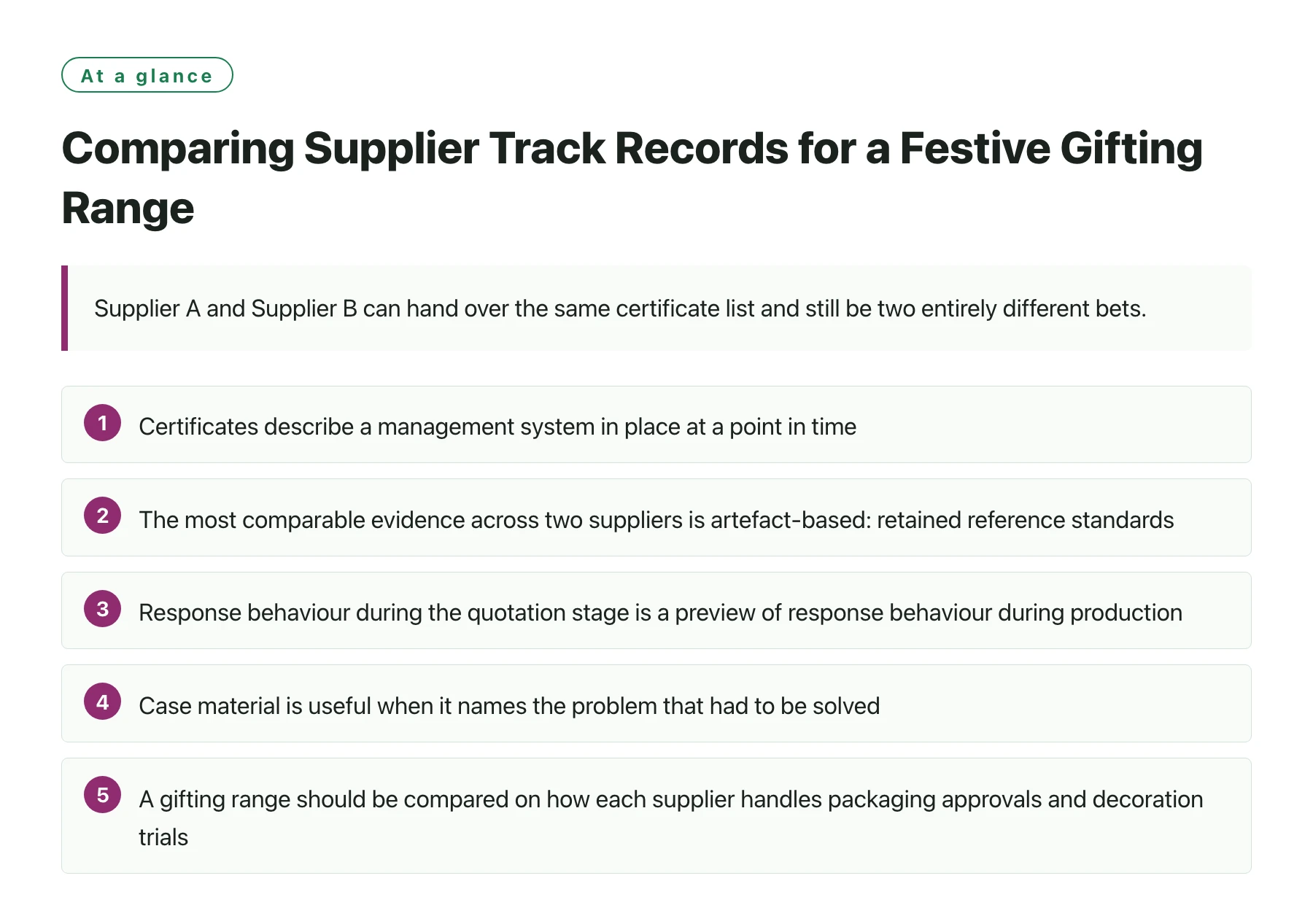
Key takeawaysCertificates describe a management system in place at a point in time; they say nothing about how a fixed gifting deadline is protected when a component arrives late. · The most comparable evidence across two suppliers is artefact-based: retained reference standards, version-controlled specifications, and test reports the buyer is allowed to see. · Response behaviour during the quotation stage is a preview of response behaviour during production, and it is the cheapest signal available before any commitment is made. · Case material is useful when it names the problem that had to be solved, and close to worthless when it only lists product categories. · A gifting range should be compared on how each supplier handles packaging approvals and decoration trials, because that is the part of the calendar with the least slack. · The honest comparison question is not which supplier is better but which supplier's way of working matches the brand's own decision speed.
First-time founders tend to compare suppliers on the things that are easy to list: certifications, categories served, price per unit and website polish. All four are worth knowing, and none of them separates two competent factories from each other. That separation shows up in the operational detail that only becomes visible once a project is underway.
A gifting programme makes the difference unusually clear, because it leaves no room for a supplier's normal recovery mechanism. There is no second ship date in December. A range that misses the window is not late; it is next year's stock. Under that pressure, the supplier's habits rather than its capabilities determine what happens.
This comparison is written from the position of a founder who has one project and two quotes in front of them, and it sets out what to ask each supplier so that the answers are genuinely comparable.
Supplier A versus Supplier B: what to compare and what the answers mean
| What you are comparing | Supplier A signal | Supplier B signal | What it tells you |
|---|---|---|---|
| Speed and quality of the quotation | Quote arrives with assumptions listed, exclusions named, and open questions flagged | Quote arrives fast with a single unit price and no stated assumptions | Supplier A has been through this conversation often enough to know where the ambiguity sits; Supplier B may be quoting optimistically |
| Evidence of repeat production | Retained reference standards and version-controlled specifications are offered without being asked for | References are described verbally, documents are promised later | A supplier that keeps references as routine practice is built for reorders, which is what a gifting range becomes |
| Packaging and decoration control | Names the decoration trials, the approval gate and who signs the decorated sample | Treats decoration as a purchasing line rather than a production stage | Decoration is where gifting calendars are usually lost, so this answer predicts the ship date better than the fill capacity does |
| Handling of a late component | Describes a specific escalation path and states what it can and cannot absorb | Says it will manage it and does not describe how | Willingness to define limits is a sign of operational maturity; a blanket reassurance is a sign that no one has modelled the case |
| Case material | Describes the problem a project had and how it was resolved | Lists categories, channels and years of activity | Only the first kind of case material transfers any knowledge to the buyer |
| Documentation at handover | States what the brand receives: formula record, test reports, artwork files, retained reference | States that everything is provided as standard | Handover specifics determine whether the second order is a purchase order or a new project |
The pattern in this table is deliberate: every row asks for something a supplier either has or does not, rather than something it can assert. That is what makes the two columns comparable. A brand that wants to see how the answers hold up under scrutiny can look at published project material first; the case pages maintained by Xuelei Fragrance exist precisely to show the problem-and-resolution form rather than a category list.
Why track records matter more in gifting than in core lines
A core fragrance line can absorb a two-week slip by extending a phase-in. A gifting range cannot, because the commercial value of the product is concentrated in a window that closes on a known date. Under that constraint, the supplier's operating habits are not a soft factor; they are the schedule.
This is also why a track record cannot be reduced to a count of years or a list of markets. Two factories can both have decades of experience and behave very differently when a decorated component arrives with a colour variation. The useful question is what the habit is when something goes wrong, and the only reliable way to learn that before committing is to look at how the supplier describes past problems.
Ask for the version history, not the finished story
A quick way to separate the two columns is to ask for the version history of a recent development. Any real project has revisions: a formula adjusted for stability, an insert re-cut, a decoration pass changed. A supplier that can describe the sequence of changes, and why each one happened, is describing a controlled process. One that presents a project as flawless is either editing the story or has not tracked it.
The same request applied to a gifting format is even more revealing, because festive ranges usually involve the most revisions relative to their development time. Ask which revision triggered the final approval and what the cost of that revision was, and whether it fell inside the quoted scope.
Compare decision speed, not just capacity
Capacity is a number; decision speed is a behaviour. A brand with a short internal approval cycle and a supplier with a weekly review meeting will lose more time to coordination than to production. Asking each supplier how quickly a change to artwork or a decoration pass can be authorised, and who holds that authority, exposes a mismatch before it becomes a missed window.
Where a brand is evaluating a partner's broader operating picture, the calibration questions in how to vet a custom fragrance manufacturer cover the same ground in a form that can be asked on a first call. Running both suppliers through one list of questions, in the same order, is the only way the resulting notes can be compared at all.
If the two suppliers still look equal after the table and the version-history question, decide on the one whose working rhythm matches the brand's own. A supplier that reviews weekly is a poor fit for a team that approves daily, and a supplier that expects rapid decisions is a poor fit for a team that meets monthly. On a gifting range, a rhythm mismatch costs more days than a slightly higher unit price ever will. It is also the point at which a founder should read about Xuelei in the same evidence-first way, as a record of how a manufacturer describes itself rather than as a claim to accept outright. Consumer demand patterns behind seasonal launches are tracked by research houses such as those publishing through the Mintel press centre, which is one place to sanity-check assumptions about what a gifting buyer responds to [1].
Sources
- Mintel Press Centre —— Mintel's press releases on consumer and beauty market research, including fragrance and personal care trend reporting.
Frequently asked questions
Do certifications differentiate fragrance suppliers?
They confirm that a management system was audited, which is useful but not differentiating, since many manufacturers in the same market hold comparable certificates. What differentiates them is how those systems behave under pressure, which is visible in retained references, version control and the way problems are described.
What is the single most useful document to request from two suppliers?
A specification with its revision history. It shows whether changes are recorded, whether the current version is identifiable, and how the supplier handles the adjustments that every real project produces. A finished-looking story with no revisions is usually a story that was not tracked.
How should a brand use case studies in a comparison?
Read them for the problem, not the product. A useful case describes the constraint that made a project difficult and what was changed to resolve it. Category lists and channel lists tell you where a supplier has sold, not how it behaves when a deadline is tight.
Is a larger supplier always the safer choice for a gifting range?
Not necessarily. Larger operations often have more capacity but less flexibility, and flexibility is what a compressed gifting calendar requires. The relevant question is whether the supplier's decision-making rhythm fits the brand's own, because a mismatch costs time that the calendar does not replace.
When should the comparison happen relative to the brief?
Before the brief goes out, ideally. The answers change what the brief should ask for, particularly on packaging and testing, and a brief written after the comparison tends to produce quotes that are genuinely comparable rather than superficially similar.